Sustainability: Aquifer thermal energy storage
Thursday, 13 January 2022

Royal Burgers' Zoo has been a proud holder of Green Key Gold since the recreation & leisure industry and business market category was added to the sustainable business eco-label in 2004. In the Netherlands, the eco-label comprises many compulsory standards and several optional standards. The extent to which an organisation meets the optional standards determines whether it is awarded Bronze, Silver or Gold.
The international hallmark assesses an organisation's sustainable entrepreneurship in the following areas: management (compliance with regulations), communication, social involvement, water, cleaning, waste, energy, building and greenery, guest and employee mobility, food and drink, purchasing and textiles. A concrete, practical example is discussed each month in a series of articles on sustainable entrepreneurship at Burgers' Zoo.
Aquifer thermal energy storage (ATES) and solar panels
Burgers' Zoo is internationally known for its so-called eco-displays where large-scale natural habitats are recreated as realistically as possible, with animals often living in great freedom amidst thousands of plants. However, some of these eco-displays are heat-intensive, such as the Bush (tropical rainforest) and the Mangrove (saltwater tidal forest). Other eco-displays, such as the Ocean (tropical coral reef), require both heat and regular cooling, especially in summer. The temperature of the living coral reef varies throughout the year from 24.5 degrees Celsius in winter to 26.5 degrees Celsius in summer. Cooling is often required because of the enormous lamps. Temperature changes must be gradual to avoid the same problems as in nature, where reefs are dying due to climate warming.


Burgers' Zoo uses the energy it needs as sparingly and sustainably as possible using ATES—aquifer thermal energy storage. The Bush and the Mangrove have a surplus of (natural) heat in summer. We store this excess energy in an underground water reservoir. There is an additional need for energy to maintain the temperature in winter, so the stored heat is pumped up. It only requires partial reheating, which saves a lot of energy every year.
In winter, there is a natural surplus of cold. We store this surplus in a different underground water reservoir. Especially in summer, the Ocean requires extra cooling to keep temperatures from rising too high. This stored cold comes in very handy! Storing cold enables us to achieve another significant energy saving.
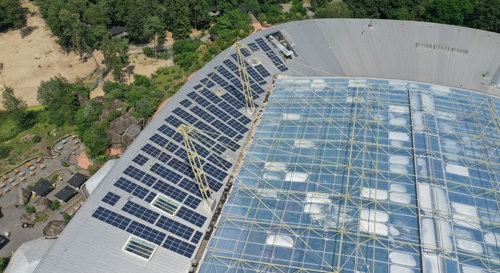
We have also created our own 'solar panel park' on the roof of the Safari Meeting Centre. With the energy that these solar panels generate each year, we can run all the electrical equipment—pumps, lighting, filter systems—in the Mangrove, and we still have a nice surplus of energy for other purposes in our park! The Mangrove is heated and, on very hot days, cooled using the ATES unit.
Also interesting

Adventurous firefly sparks spectacular light show at Burgers’ Zoo
Seven years since the last edition, Burgers’ Zoo is organising a reimagined version of its enchantin…
22 September 2026

Burgers' Zoo developing world's largest seagrass aquarium
Royal Burgers’ Zoo is developing the world’s largest seagrass aquarium, with a volume of over 50,000…
6 August 2026

Burgers' Zoo opens Desert after extensive remodelling
After months of work to renovate a large section of the Desert, Royal Burgers’ Zoo reopens the Ameri…
9 July 2026